
How to Assess Fabric Quality Online: A 2026 Guide
Table of Contents
- Start with the Product Description: What to Look For
- What Is Fabric GSM and Why It Matters for Quality
- How to Read Fabric Composition Labels Like a Pro
- Visual Inspection Techniques for Online Shopping
- The Best Fabric for Evening Gowns: What to Prioritize
- Digital Tactile Proxies: Judging Touch Without Touching
- Return Policy as a Quality Indicator
- Fabric Care Label Decoding: What It Says About Durability
- Common Mistakes to Avoid When Assessing Fabric Quality Online
- Frequently Asked Questions
Last Updated: September 14, 2026
Start with the Product Description: What to Look For
Learning how to assess fabric quality online starts with the product description, because that text is your first and most reliable substitute for touching the garment. At EllaVerra Boutique, we read hundreds of listings a week, and the pattern is consistent: the listings that hold up under scrutiny name their fibers, their weight, and their construction. The ones that hide behind words like "luxe" or "premium blend" almost never survive a close read.

Two details do most of the work: fiber content and fabric weight. If a listing gives you both, you can predict how a dress will drape, breathe, and hold up long before it ships. If it gives you neither, treat that silence as information. The Federal Trade Commission's textile labeling guidance requires sellers to disclose fiber content by percentage, so a vague description is a choice, not an oversight.
Identify Fiber Content and Material Composition
Fiber content is the percentage breakdown of each material in a garment, listed from highest to lowest. Natural fibers like silk, cotton, and wool behave differently from synthetic fibers like polyester, nylon, and spandex, and the ratio between them decides almost everything about how the fabric feels and performs. A gown that is 95% polyester and 5% spandex will stretch and recover; a 100% silk gown will drape with weight and movement but demand careful care. Look for a full percentage list, not just a list of names.
Check Fabric Weight and Density (GSM)
Fabric weight is measured in GSM, or grams per square meter, and it tells you how substantial a material is. A listing that publishes GSM is telling you the maker tracks textile quality at the mill level. Lightweight fabrics under roughly 150 GSM feel airy and sheer; midweight fabrics in the 150-250 GSM range hold structure; heavier fabrics above that drape with real presence. Density matters just as much as weight, because a tightly woven fabric resists pilling and transparency even when it is thin.
What Is Fabric GSM and Why It Matters for Quality
Fabric GSM is the weight of one square meter of fabric expressed in grams, and it is the single most useful number for predicting how a dress will behave in person. Two fabrics can share the same fiber content and still feel completely different because one is 90 GSM and the other is 240 GSM. GSM sits at the intersection of fabric density, drape, and durability, which is why we treat it as a quality signal rather than a spec sheet footnote.
Here is how the ranges translate into real garments:
| GSM Range | Weight Class | How It Behaves | Typical Use |
|---|---|---|---|
| Under 150 | Lightweight | Flowy, can be sheer | Summer dresses, linings |
| 150-250 | Midweight | Holds shape, drapes well | Structured gowns, satin |
| 250-350 | Heavyweight | Substantial, sculptural | Tailored pieces, crepe |
| Above 350 | Very heavy | Rigid, formal | Outerwear, heavy crepe |
The American Society for Testing and Materials textile standards formalize how fabric weight and tensile strength are measured, which is why a maker who publishes GSM is usually a maker who tests.
How to Read Fabric Composition Labels Like a Pro
Reading a composition label well means reading it in order. Materials are listed by percentage, highest first, so the first fiber named sets the tone for the entire garment. A label that leads with silk and finishes with a trace of spandex describes a fluid, forgiving gown. A label that leads with polyester describes a fabric engineered for durability and wrinkle resistance, which is not a flaw, just a different trade-off.
Decoding Natural vs. Synthetic Fibers
Natural fibers bring breathability, moisture-wicking, and a distinctive fabric hand, the way a material feels against skin. Silk has weight and luster; cotton breathes; wool regulates temperature. Synthetic fibers bring stretch, shape retention, and resistance to shrinkage. Neither category is inherently better. The question is whether the blend matches the occasion. For a gala gown you plan to wear for four hours, a silk blend with a touch of spandex often outperforms pure silk because it moves without creasing.
Visual Inspection Techniques for Online Shopping
Visual inspection online is not about admiring the dress, it is about extracting measurable signals from photos and video. Most shoppers scroll; careful shoppers zoom, count, and compare. Treat every listing as a small dataset: the more angles, lighting conditions, and close-ups a seller provides, the more you can verify before you buy.

Zooming in on Stitching and Construction Quality
Stitching quality is visible if you know what to count. On a standard seam, look for a stitch density of roughly 10-12 stitches per inch on fine garments; sparse, widely spaced stitches (under 8 per inch) signal a faster, cheaper construction (astm.org). Check four things in every close-up:
- Seam evenness. The stitch line should run parallel to the fabric edge with no wobble or puckering. Puckering means the fabric was fed unevenly through the machine.
- Pattern matching at seams. On prints and plaids, the pattern should align across the seam. Misalignment means the maker cut for speed, not accuracy.
- Hem finish. A cleanly finished hem (rolled, blind-stitched, or bound) holds up; a raw or serged-only hem on a formal garment is a cost shortcut.
- Zipper and lining attachment. Zippers should sit flush without rippling the fabric beside them. Lining should be attached at the waist or shoulders, not hanging free.
If a listing shows no close-ups of seams, hems, or the zipper, that absence is itself a signal. Sellers confident in construction photograph it.
Evaluating Drape and Transparency from Photos
Drape is how fabric falls under its own weight, and photos capture it better than most shoppers realize, if you know what to look for. Study three things:
- How the fabric pools at the hem. Fluid fabrics (silk, crepe, high-quality satin) form soft, rounded folds. Stiff fabrics form angular, standing folds.
- How it catches light. A matte surface (crepe, wool) absorbs light; a lustrous surface (satin, silk charmeuse) reflects it. The sheen tells you about the weave and finish, not just the fiber.
- How it moves in video. If the listing includes a video, watch the hem and sleeves. Fabric that swings and settles smoothly has good drape; fabric that snaps back stiffly is heavily finished or synthetic-heavy.
For transparency, look for a lining mentioned in the description and check photos taken in bright, direct light, that is where sheer fabrics reveal themselves. A quick at-home test once the dress arrives: hold it up to a window. If you can read text through it, the fabric is sheer and needs a slip. If you can see the outline of your hand but not read through it, it is semi-opaque and likely fine for most settings.
The Best Fabric for Evening Gowns: What to Prioritize
The best fabric for an evening gown is the one whose weight, weave, and fiber match the silhouette you want, not the one with the most luxurious name. This is where the specs you have already learned (GSM, fiber content, weave structure) become a decision tool. Most shoppers pick a silhouette first and then hope the fabric cooperates. Do it the other way around and you will rarely be disappointed.
Here is how the major silhouettes map to fabric specs:
| Silhouette | Ideal GSM Range | Best Weave/Fiber | Why |
|---|---|---|---|
| Flowing A-line or bias-cut | 90-150 | Silk charmeuse, crepe de chine, lightweight satin | Needs to move with the body and pool at the hem |
| Draped bodice or cowl neck | 150-220 | Sandstone crepe, matte satin, silk blend | Needs enough weight to sculpt folds without collapsing |
| Structured bodycon | 220-320 | Heavy crepe, ponte, scuba knit | Needs density to skim the body and hold a seam line |
| Tailored midi or column | 250-350 | Wool crepe, heavy satin, bonded fabrics | Needs structure to stand away from the body |
| Ball gown or sculptural | 300+ | Heavy crepe, taffeta, duchesse satin | Needs weight to hold volume and resist collapsing |
A few rules of thumb that follow from the table:
- Structure needs weight. A bodycon under 200 GSM will cling and show every seam and undergarment line. Look for 220 GSM or higher.
- Flow needs lightness. An A-line over 250 GSM will stand away from the body instead of moving with it. Look for under 180 GSM.
- Drape needs the right weave, not just the right weight. A 200 GSM satin and a 200 GSM crepe behave differently because the weave changes how the fabric folds. Satin drapes with a liquid sheen; crepe drapes with a matte, pebbled surface.
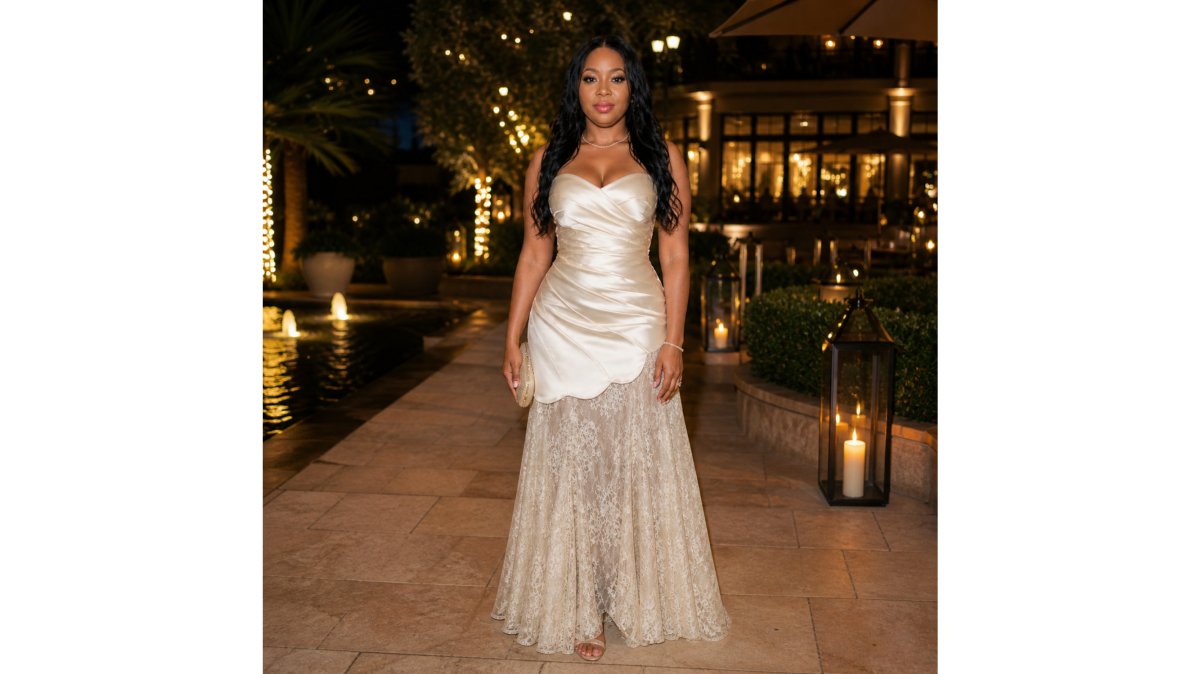
Our Cream Satin Draped Dress is a good example of matching fabric to silhouette: the draped bodice needs a fabric with enough weight to sculpt, and the fluid skirt needs one light enough to flow. The Power Line Structured Bodycon Midi Dress takes the opposite approach, using a substantial, structured fabric to hold a sharp, tailored line.
Digital Tactile Proxies: Judging Touch Without Touching
Digital tactile proxies are the signals that stand in for touch when you shop online: GSM, fiber content, weave structure, and the language a seller uses to describe fabric hand. You cannot feel a dress through a screen, but you can read the specs that predict how it will feel. A listing that names its weave, its weight, and its fiber blend has given you a genuine proxy for touch.
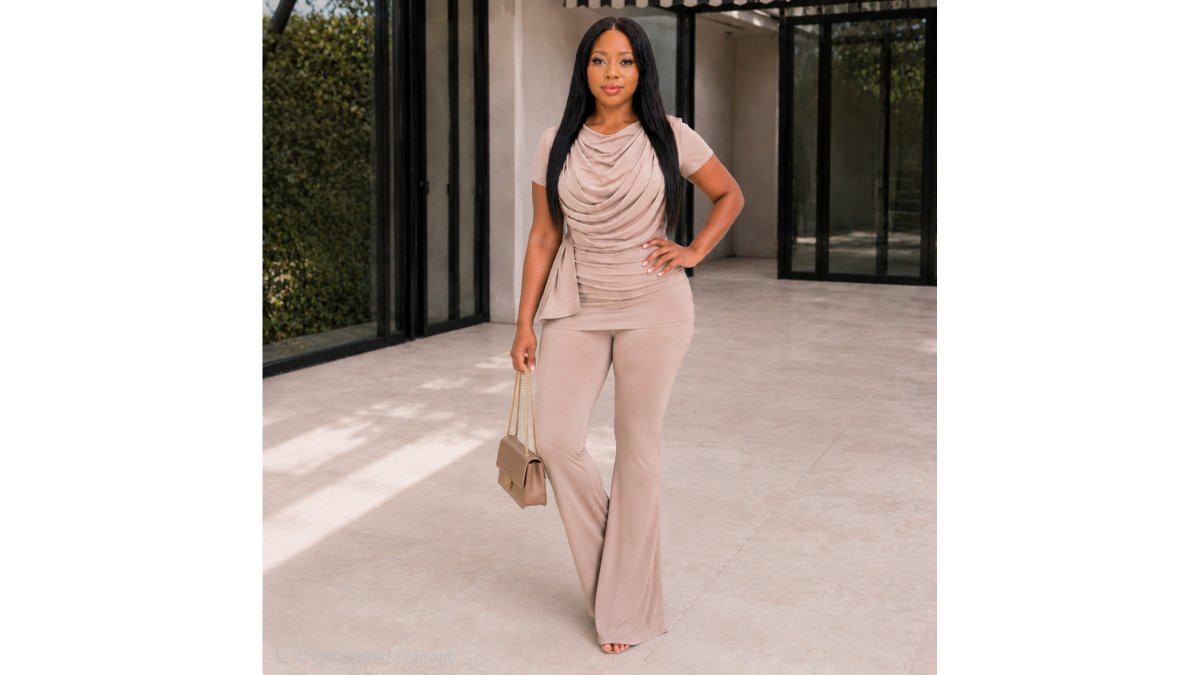
This is where most listings fail, and where careful shoppers gain an edge. When a description says "soft, luxurious fabric" with no numbers, you are being asked to trust marketing. When it says "sandstone stretch crepe, midweight, with a matte surface finish," you can picture the fabric hand before it arrives. The Isla Two-Piece Set describes its sandstone stretch crepe this way, which lets you anticipate the drape and the way the cowl neckline will fall.

Return Policy as a Quality Indicator
Return policy is a quality indicator because sellers who trust their product make returns easy. A generous, clearly stated return window signals confidence in construction, fit, and color accuracy. A policy buried in fine print, or one with a window so short you cannot realistically try a gown and decide, tells you the seller expects a certain number of unhappy customers.
Read the policy before you read the reviews. Look for the length of the window, who pays return shipping, and whether sale items are excluded. If a boutique makes returns difficult, the risk of a poor fit or a color that looks different in person lands entirely on you. That risk is part of the true cost of the garment.
Fabric Care Label Decoding: What It Says About Durability
Care labels reveal durability before you ever wash the garment. A dress that requires dry cleaning only is often made from a delicate fiber or a surface finish that water would damage. A dress that can be machine washed cold and hung to dry is usually built from a fabric engineered to hold its colorfastness and shape through repeated wear.
Decode the symbols by category: a washtub with a number sets the temperature, a triangle governs bleach, a square with a circle covers tumble drying, and an iron sets heat limits. A care label that permits gentle washing and low-heat ironing describes a fabric with real tensile strength and color consistency. One that demands dry cleaning and no ironing describes a fabric you will spend money maintaining. Neither is wrong, but the label tells you which gown fits your life.
Common Mistakes to Avoid When Assessing Fabric Quality Online
The biggest mistakes in assessing fabric quality online come from trusting adjectives over specifications. Here are the traps we see most often:
- Buying on the word "satin" alone. Satin is a weave, not a fiber. Without a fiber name, you cannot predict the fabric hand.
- Ignoring GSM. A listing with no weight data gives you no way to judge drape or density.
- Skipping the return policy. A short window turns a fit risk into a sunk cost.
- Judging color from one photo. Lighting changes how dye reads. Look for multiple angles and natural-light shots.
- Assuming higher price means better fabric. Price tracks brand and design as much as material. Check the specs, not the tag.
- Overlooking shrinkage. A fabric prone to shrinking will change fit after the first wash. Care instructions tell you what to expect.
Assessing fabric quality online comes down to reading what a listing actually tells you, and most listings tell you less than they should. At EllaVerra Boutique, we publish fiber content, weight, and construction details because we would rather you know exactly what you are buying. Our collection spans evening and gala gowns, modest clothing, and custom design services, with free shipping on orders over $200 and flexible payment options including Shop Pay and AfterPay. Get started with EllaVerra Boutique and find a gown you can trust before it ever arrives.
Frequently Asked Questions
How can I tell if a fabric is high-quality just by looking at product photos?
Look for close-up shots that show the weave structure and surface texture. High-quality fabrics have tight, even weaves with no loose threads or gaps. Check for consistent dye across the entire garment, as uneven color often signals poor quality control. Photos that show the fabric draped or in motion reveal how it flows and catches light, which indicates fiber fineness and weight. Avoid listings with only flat, low-resolution images that hide construction details.
What are the best fabric indicators to look for in online product descriptions?
Prioritize listings that specify fiber content (e.g., 100% silk, 95% cotton/5% elastane), fabric weight in GSM, and weave type (satin, crepe, twill). These details let you predict drape, durability, and breathability. Also look for mentions of colorfastness, shrinkage, and care instructions. A description that omits these basics likely indicates lower quality or a seller who doesn't know their product well.
Why is fabric weight important when shopping for formal gowns online?
Fabric weight, measured in GSM, determines how a gown drapes and feels. Lightweight fabrics (under 150 GSM) like chiffon create airy, flowing silhouettes but may be sheer and less durable. Midweight fabrics (150-250 GSM) like crepe and satin offer structure and opacity, ideal for evening gowns. Heavyweight fabrics (over 250 GSM) like velvet or brocade provide warmth and a luxurious hand but can be stiff. Matching GSM to the gown's design ensures the final look meets expectations.
How do I interpret textile composition labels on retail websites?
Composition labels list fibers in descending order by percentage. Natural fibers like silk, cotton, and wool often signal higher quality and breathability, while synthetic fibers like polyester and nylon add durability and wrinkle resistance. Blends can combine benefits: a silk-cotton blend may offer sheen with breathability. Be wary of vague terms like 'premium blend' without specifics.
%0A%0A%0AWhat%20Is%20Fabric%20GSM%20and%20Why%20It%20Matter...)