How to Style Modest Wedding Guest Dresses in 2026
Table of Contents
- What You'll Need Before You Start Styling
- What Defines a Modest Wedding Guest Dress
- Step 1: Match Your Dress to the Wedding Guest Dress Code
- Step 2: Solve the Undergarment Question First
- Step 3: Layer with a Bolero, Shawl, or Jacket
- Step 4: How to Accessorize Modest Dresses Without Overdoing It
- Step 5: Choose Footwear That Balances Coverage and Comfort
- Modest Evening Gowns for Mature Women: Adjusting the Approach
- Building a Capsule of Modest Wedding Guest Outfits
- Common Mistakes to Avoid When Styling Modest Wedding Guest Dresses
- Frequently Asked Questions
Last Updated: September 13, 2026
What You'll Need Before You Start Styling
Before you style anything, gather three things: the dress, the dress code, and the right underlayers. Wedding guest dressing gets much easier once you stop guessing and start with a plan. This guide from EllaVerra Boutique walks through how to style modest wedding guest dresses step by step, from matching the invitation's formality to choosing the layer that finishes the look.
Most styling mistakes happen before anyone opens a closet. They happen because a guest bought a beautiful dress without checking what the couple actually asked for. A floor-length gown at a casual backyard ceremony reads as trying too hard. A sundress at a black-tie reception reads as not trying at all.
Here is a simple pre-styling checklist:
- Read the invitation for an explicit dress code
- Note the venue: indoor ballroom, outdoor garden, or house of worship
- Check the season and expected temperature
- Confirm your undergarment plan before the dress arrives
- Choose one layer and one accessory focal point, not three
The five steps below cover dress code matching, undergarments, layering, accessories, and footwear. Get those five right and the rest of the outfit falls into place.
What Defines a Modest Wedding Guest Dress
A modest wedding guest dress is one that covers the shoulders, chest, and knees or lower while keeping a flattering, intentional silhouette (merriam-webster.com). Modesty is a styling choice, not a limitation, and it works best when the coverage looks deliberate rather than added on at the last minute. But modesty is not one-size-fits-all. What reads as modest at a secular garden ceremony may not meet the standards for a religious service, and the reverse is also true. Understanding the spectrum helps you dress appropriately for any wedding on your calendar.
Coverage Points: Sleeves, Necklines, and Hem Lengths
Three coverage points decide whether a dress reads as modest: the sleeve, the neckline, and the hem.
- Sleeves: Long sleeve evening gowns offer the most coverage; cap sleeves and three-quarter sleeves are middle ground; sleeveless styles work if you plan to add a layer.
- Necklines: A high neckline, bateau, or mandarin collar covers the chest without looking severe. Deep V and sweetheart cuts can still work when paired with a structured layer.
- Hems: Midi length falls at the calf; floor-length reaches the ground. Both read as elegant coverage for formal events, while a knee-length hem suits casual ceremonies.
The goal is balance. If the neckline is high, you can go sleeveless. If the hem is long, a lighter fabric keeps the look from feeling heavy.

Cultural and Religious Considerations
Modesty standards shift depending on the wedding's cultural or religious context. If you are attending a ceremony in a house of worship, the venue itself often signals a more covered approach. Here is how to adapt without buying a separate wardrobe:
- Hindu weddings: Many ceremonies take place in temples or under a mandap, where removing shoes is required and covering the head may be respectful. A floor-length dress with a shawl that can double as a head covering works well. Bright colors are often welcomed, but avoid all-black and all-white.
- Jewish weddings: Orthodox ceremonies may call for sleeves that cover the elbow and necklines that cover the collarbone (myjewishlearning.com). A midi or floor-length dress with a tailored jacket or bolero meets most standards. If the ceremony is in a synagogue, a shawl or wrap is useful for the same reason.
- Muslim weddings: Modesty standards vary by family and culture. A safe approach is a floor-length dress with long sleeves and a high neckline, plus a shawl that can be draped if the venue requires head covering. Loose, flowing fabrics are often preferred over clingy ones.
- Christian weddings: Standards range from casual to formal. In more traditional denominations, covered shoulders and a hem at or below the knee are respectful. A midi dress with a light cardigan or bolero adapts to almost any church setting.
When in doubt, err on the side of more coverage and bring a layer you can remove if the reception is more relaxed. A wrap or shawl is the single most versatile tool for navigating a ceremony with stricter standards and a reception with looser ones.
Fabric Weight and Seasonal Considerations
Fabric weight matters more than most guests expect. A structured crepe or satin holds its shape through a long reception, while chiffon and georgette drape softly and photograph well in warm weather. For summer weddings, lighter fabrics with covered shoulders keep you cool. For fall and winter, heavier fabrics with long sleeves do the same job in reverse.

Step 1: Match Your Dress to the Wedding Guest Dress Code
The fastest way to get modest wedding guest dress codes right is to read the invitation literally. If it says black tie, wear a floor-length gown. If it says semi-formal, a midi or floor-length dress works. If it says casual, skip the gown entirely.
Black Tie, Semi-Formal, and Casual: What Changes
| Dress Code | Hem Length | Coverage Approach | Best For |
|---|---|---|---|
| Black tie | Floor-length | Long sleeves or covered shoulders, high neckline | Evening galas, formal ballrooms |
| Semi-formal | Midi to floor-length | Cap or three-quarter sleeves, structured bodice | Most weddings |
| Cocktail | Midi | Sleeveless with a bolero or shawl | Reception-only invitations |
| Casual | Knee to midi | Any coverage, relaxed fabric | Backyard or daytime ceremonies |
Black tie is the strictest: floor-length gowns, elegant coverage, refined accessories. Semi-formal gives you room to move between midi and floor-length depending on the venue. Casual is where modest styling gets creative, since a simple midi with covered shoulders fits almost anywhere.
When the invitation is silent on dress code, match the venue. A hotel ballroom signals formal attire; a beach or park signals something relaxed. The Emily Post Institute guidance on wedding guest attire is a useful reference when an invitation leaves you guessing.
Step 2: Solve the Undergarment Question First
Undergarments decide whether a modest dress actually looks modest once you're moving, sitting, and dancing. Sort this out before you shop for accessories, because the wrong foundation can change how a dress fits entirely. This is the step most guides skip, yet it is the one that prevents the mid-reception tugging and readjusting that ruins an otherwise polished look.
A few practical rules:
- Choose a seamless bra that matches your skin tone rather than the dress color. Nude is not one shade; find a tone that disappears under your specific fabric.
- For high necklines, a smooth contour bra prevents visible lines. If the neckline is very high, consider a bra with convertible straps that can be crossed in the back to avoid strap peek.
- For draped bodices, a fitted slip or shaping layer keeps fabric from clinging. Look for slips with a touch of spandex so they move with you, not against you.
- For floor-length gowns, consider a half-slip so the skirt moves without static. A static-cling spray on the inside of the skirt is a quick fix if you are short on time.
What most guides miss is that undergarments affect the neckline as much as the hem. A bra that sits too low pulls a modest neckline down with it. Try the dress on with your planned undergarments before you commit to alterations.
Solutions for Specific Modest Necklines and Sleeves
Different modest silhouettes demand different undergarment strategies. Here is how to solve the most common challenges:
- High necklines (mandarin, bateau, mock turtleneck): A bra with a low-profile back closure prevents bumps under fitted fabric. If the dress is backless or has a keyhole, use adhesive cups or a backless bra with silicone wings. For extra security, fashion tape along the inner edge of the neckline keeps it from gaping when you lean forward.
- Sleeveless or cap-sleeve dresses with a layer: The layer (bolero, shawl, jacket) will shift. Wear a seamless bra with wide straps that won't dig, and consider a bra liner to absorb moisture if you'll be dancing. A common pattern is to pin the layer to the bra strap at the shoulder to keep it from sliding.
- Sheer or lace sleeves: These are decorative, not covering. Wear a nude or matching-tone camisole or a long-sleeve seamless top underneath. Look for tops with a raw edge that won't show under the dress.
- Deep V or sweetheart necklines with a modesty panel: The panel is only as good as the bra behind it. A plunge bra with a low center gore works, or use a lace modesty panel that attaches to the bra itself.
The Movement Test
Before you commit to a dress, do the movement test in front of a mirror: sit down, cross your legs, raise your arms as if to toast, and bend forward as if picking up a dropped napkin. If any undergarment shifts, shows, or creates a line, adjust the foundation before you buy. Most practitioners find that a dress that passes the movement test with the right undergarments needs fewer alterations and feels more secure all night.
Step 3: Layer with a Bolero, Shawl, or Jacket
A layer is the single most useful tool for modest styling, because it adds coverage without changing the dress. The three workhorses are the bolero, the shawl, and the structured jacket.

A bolero is a short, cropped jacket that covers the shoulders and upper arms while leaving the waistline visible. It suits structured silhouettes and works well over sleeveless or spaghetti-strap dresses. A shawl drapes over the shoulders and can be wrapped, pinned, or worn loose; it photographs beautifully and packs flat. A tailored jacket reads more formal and suits cooler months.
How to style a bolero or shawl without ruining the line:
- Match the layer to the dress fabric weight, not just the color
- Keep the layer shorter than the dress hem so the silhouette stays visible
- Pin a shawl at one shoulder for a draped, asymmetrical look
- Choose a neutral layer if the dress already has a bold print
Step 4: How to Accessorize Modest Dresses Without Overdoing It
Accessories should support the dress, not compete with it. The rule for how to accessorize modest dresses is simple: pick one focal point and let everything else stay quiet.
If the dress has a high neckline, skip the statement necklace and wear earrings instead. If the neckline is open, a pendant or short strand adds interest without clutter. A clutch is the standard evening bag, but a small structured bag with a wrist strap frees your hands during dinner.
- Jewelry: One focal piece, maximum two
- Bag: Clutch or wristlet in a neutral or matching tone
- Hair: An updo or half-up style keeps the neckline visible
- Wrap: Optional, but useful for outdoor ceremonies after dark
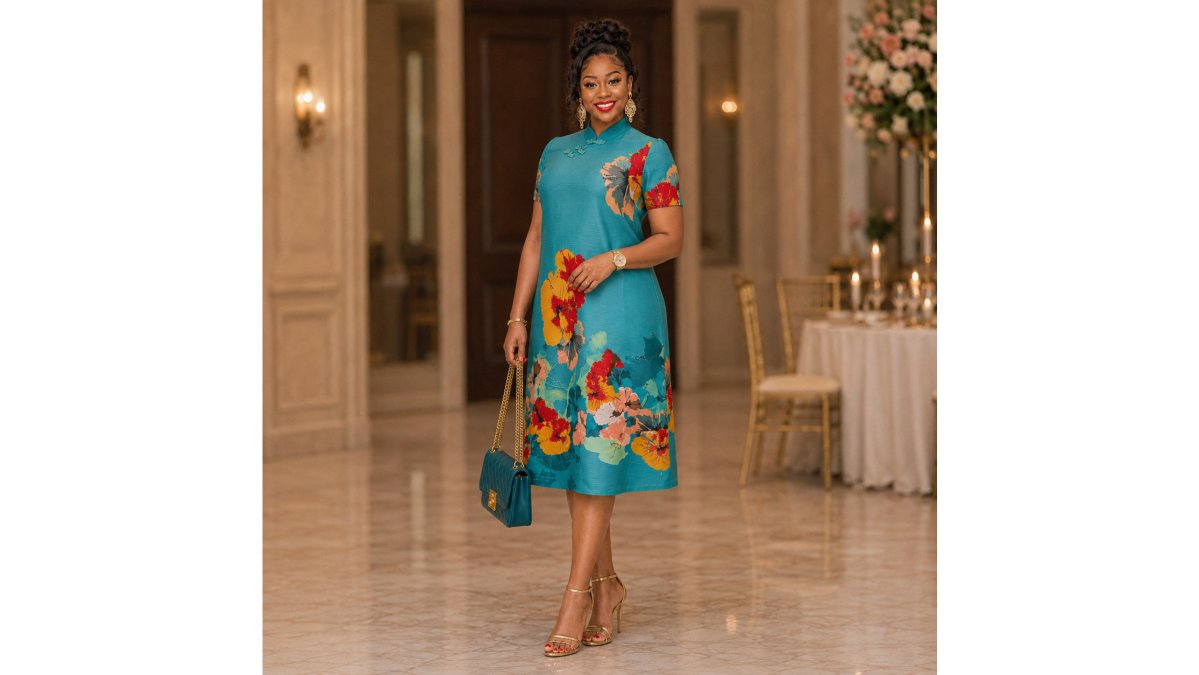
For a dress with a bold floral print, like a watercolor teal A-line with decorative frog-button detailing, keep jewelry minimal and let the print carry the look. EllaVerra Boutique's Teal Blossom Mandarin Collar A-Line Dress is a good example: the mandarin collar and short sleeves already provide elegant coverage, so a simple earring and a small clutch finish it.
Step 5: Choose Footwear That Balances Coverage and Comfort
Footwear has to survive the ceremony, the cocktail hour, and the dancing. For modest formal looks, a closed-toe pump or a low block heel keeps the line clean and stays comfortable for hours.
Consider the venue surface before you choose. Grass and gravel punish stiletto heels. A block heel or a dressy flat handles uneven ground without sinking. For black-tie events, a pointed closed-toe pump in a neutral tone works with almost any gown. For semi-formal and cocktail dress codes, a strappy sandal or a mid-height heel is fine.
Modest Evening Gowns for Mature Women: Adjusting the Approach
Modest evening gowns for mature women often need small adjustments rather than a different style direction. The coverage principles stay the same; what changes is the emphasis on structure, comfort, and fabric quality.
Structured silhouettes tend to flatter more than clingy ones. A defined waistband, a draped bodice, or a fitted bodice over a flowing skirt creates shape without relying on tight fabric. Sleeve length is a personal call: three-quarter sleeves offer coverage and freedom of movement, while long sleeves suit cooler venues.
Fabric quality shows more in photographs as you get older, not less. A heavier crepe or a lined chiffon holds its shape and reads as refined where a thin, unlined fabric can look tired by the end of the night.
Building a Capsule of Modest Wedding Guest Outfits
A capsule approach saves money and decision fatigue. Instead of buying a new dress for every invitation, build a small set of pieces that mix across events.
A workable modest wedding guest capsule includes:
- One floor-length gown in a neutral or deep tone for black-tie events
- One midi dress in a print or earthy neutral for semi-formal weddings
- One bolero or tailored jacket that works over both
- One shawl in a color that flatters multiple dresses
- One pair of closed-toe heels and one dressy flat
- One clutch that reads formal enough for evening
With those six pieces, you can dress for a formal gala, a garden ceremony, and a cocktail reception without repeating a full outfit. A floor-length option like the Elegant Flow Gown in soft ivory covers the formal end, while a floral midi covers daytime events. EllaVerra Boutique also offers free shipping on orders over $200 and flexible payment options including Shop Pay and AfterPay, which helps when you're building the capsule in stages.
Rental and resale are worth considering for one-off events. If a gown will only be worn once, renting or buying secondhand keeps the cost down and keeps a good dress in circulation.
Common Mistakes to Avoid When Styling Modest Wedding Guest Dresses
Most styling problems trace back to four recurring mistakes. Avoiding them is easier than fixing them the morning of the wedding.
Mistake 1: Buying the dress before checking the dress code. A floor-length gown at a casual ceremony looks out of place. Read the invitation first, then shop.
Mistake 2: Skipping the undergarment test. Try the dress on with the bra and slip you plan to wear. A dress that fits well over the wrong foundation will not look modest in motion.
Mistake 3: Over-accessorizing. A high neckline plus a statement necklace plus bold earrings plus a patterned shawl is too many focal points. Choose one.
Mistake 4: Ignoring the venue surface and temperature. Outdoor ceremonies after dark get cold, and grass ruins thin heels. Plan the layer and the shoe around the setting.
A common mistake is treating modesty as a compromise. It isn't. A well-fitted midi with covered shoulders and one strong accessory reads as sophisticated and appropriate for almost any wedding on the calendar.
Wedding season has a way of stacking invitations faster than anyone plans for, and figuring out what to wear to each one gets exhausting. EllaVerra Boutique curates elegant wedding guest attire, gala gowns, and modest clothing in one place, with custom design services available when you want something made for you. Browse the collection, take advantage of free shipping on orders over $200, and use flexible payment options like Shop Pay and AfterPay to spread the cost. Get started with EllaVerra Boutique and find the dress that fits the occasion, the dress code, and you.
Frequently Asked Questions
What defines a modest wedding guest dress?
A modest wedding guest dress covers the shoulders, chest, and knees without looking heavy or dated. Look for high necklines, sleeves or cap sleeves, and midi or floor-length hems. Structured silhouettes and draped bodices keep the shape flattering rather than boxy. Fabric matters too: lined crepe, chiffon, and matte satin hold an elegant line while staying comfortable through a long ceremony and reception.
How do I choose the right modest dress for different wedding dress codes?
Start with the invitation wording. Black tie calls for a floor-length gown in a refined fabric, often with covered shoulders and a high neckline. Semi-formal allows a midi length with a bolero or shawl. Casual or daytime weddings work with a flowy maxi or an A-line midi in lighter prints. When in doubt, go one level dressier than the invitation suggests, since underdressing is harder to fix than overdressing.
How can I accessorize a modest dress for a formal wedding?
Keep accessories deliberate rather than numerous. A structured clutch, a single strand of pearls or a delicate pendant, and small drop earrings add polish without competing with the dress. If the gown has a high neckline, skip the necklace and let earrings carry the look. A shawl in a matching or contrasting tone gives you coverage and a finished silhouette, and it doubles as warmth if the reception runs late.
Can modest wedding guest dresses be stylish and modern?
Yes. Modesty and current style are not in conflict. Modern modest gowns use draped bodices, tiered chiffon skirts, watercolor florals, and earthy neutrals to stay fresh. The key is fit: a dress that follows your waist and skims rather than clings reads as sophisticated, not frumpy. Pieces like the Teal Blossom Mandarin Collar A-Line Dress show how a high collar and A-line cut can feel both covered and contemporary.